
Inspirational Classrooms – Teaching and Learning at The Wren
In the classroom
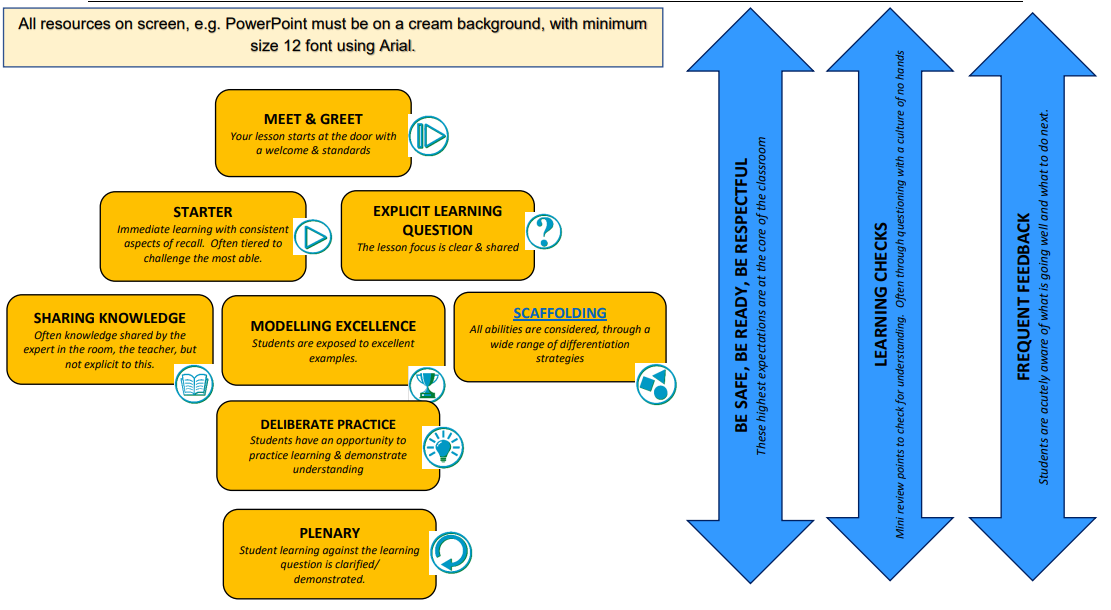
We believe in Inspirational Classrooms.
Inspirational Classrooms is our research informed approach to teaching and learning. Developed in 2021, by both our Leadership Team and our Teaching and Learning Research Group, Inspirational Classrooms was primarily inspired by Rosenshine’s Principles of Instruction by Tom Sherrington, Making Every Lesson Count by Shaun Allison and Andy Tharby and Teach like a Champion by Doug Lemov.
The purpose of the framework is to ensure that teaching staff have clarity around the expectation of teaching & learning and staff can be supported to develop these skills and aspects of their teaching. The Inspirational Classrooms framework supports our Wren vision and goal to have truly inspirational classrooms where exceptional teaching and learning is consistently seen and innovation is celebrated. As a result of this framework, teaching will be consistently good, or better throughout the school.
| Rosenshine’s Principle of Instruction: full of simplicity and clarity, Rosenshine describes 10 key principles of instruction: | Allison & Tharby’s, making every lesson count agrees with Rosenshine and summarises six principles to support great teaching and learning: |
| 1. Daily review
2. Present new material in small steps 3. Ask questions 4. Provide models 5. Guide student practice 6. Check for student understanding 7. Obtain high success rate 8. Provide scaffolds for difficult tasks 9. Independent practice 10. Weekly & monthly reviews |
1. Challenge
2. Explanation 3. Modelling 4. Practice 5. Feedback 6. Questioning
|
We believe in No Hands Up Questioning.
No hands up questioning, primarily inspired by Dylan Wiliam, who describes a strategy for formative assessment whereby teachers use “no hands up, except to ask a question.” Wiliam states “if the aim of questioning is to help the teacher find out what the students know, it makes little sense to select a respondent from the volunteers, because generally, students only raise their hands when they are confident, they have the correct answer. Instead, if the teacher is asking the question, students should be given time to think about the question, and then it should be the teacher who selects the student or students to respond, at random.” This does not mean that a student is unable to raise their hand for support, in fact we encourage this.
In addition to this, when questioning students, we believe in always ensuring students thinking time to process questions before expecting an answer because it can take a student up to 10 seconds to process what has been asked of them. This supports students with learning needs too.
Finally, we believe in ‘no opt out,’ underpinned in research by colleagues such as Tom Sherrington. No opt out is the process of checking in with a student at another point in the lesson if they are initially unable to answer a question, possibly through asking them to summarise or use their own words to phrase another student’s answer.
We believe that feedback should be frequent and varied.
Again, developed by our Teaching and Learning Research Group, feedback at The Wren aims to ensure frequent feedback for students which is considerate of the classroom needs. This is achieved through giving autonomy to the teacher to use their professional judgement and subject expertise to consider the most effective feedback type for a student, class, subject or topic to ensure that students are able to articulate:
- Where are they now?
- What do they need to do next?
Prior to implementation in January 2021 our toolkit for feedback was trialled by the Teaching and Learning Research Group over a number of weeks utilising a range of strategies in the classroom and monitoring their effectiveness and listening to student voice.
The key strategies in our toolkit include:
- Verbal feedback: the most common form of feedback where the teacher rotates the room throughout activities, engaging in dialogue with students on how to better their work with immediacy – this is a daily routine.
- Whole class feedback: the use of a whole class feedback sheet to provide feedback to the class, shared on the screen or under a visualiser, each student is provided a copy to act upon.
- Live marking: this method is where the teacher uses a visualiser, or similar, to review their own model, or student work for the benefit of the whole class, narrating where there is excellence, areas to improve and most importantly, how to improve.
- Box marking: where the teacher identifies a clear sub-section of a longer piece of work to mark. Commonly the teacher would ask for a paragraph or section to be highlighted into a box. This box is then marked in depth with student personal feedback of what to Continue (in future) and what to
- Live zonal feedback: the teacher mentally “zones” the room and over a series of lessons provides verbal, or written, personalised feedback to each student, e.g., front row in one lesson, second row next lesson etc.
- Continue, Improve marking: this is the traditional written marking in book, whereby the teacher marks a selected piece of work only and directs students what to Continue (in future) and what to Improve.
- Guided self or peer reflection, with clear success criteria: this is where students reflect upon their own, or their peers learning, providing guidance on what to Continue (in future) and Improve.
We believe in Quality First Teaching to support students with all learning needs.
At The Wren we believe in an ambitious curriculum which challenges each child and classroom teachers ensure that they provide the personalised support for the students within their class to ensure everyone can make progress. The SEND Code of Practice explains that all teachers are teachers of SEND students (DfE, 2015), what this means is that we expect each teacher to make reasonable adjustments to support students with learning needs. At TWS, we believe this is true for all students whatever their level and our Wren vision is built upon knowing each child so that we can ensure they experience an exceptional education. All electronic displays in lessons are presented in an off white/beige colour to support students who find the contrast of black text on a white background difficult to focus upon; we use Arial font, which is always of font size 12 or larger to ensure that students have a clear and visible text to process. In addition, we expect every classroom teacher to ensure that they are:
- Chunking learning
- Using explicit instructions
- Scaffolding learning
- Dual coding learning
Outside of the classroom
Wren Extra provides opportunities for each child to continue to learn outside of the classroom.
At The Wren we believe in ensuring a strong Wren Extra enrichment offer, from academic clubs to social clubs, sports, performance, book club and more. Our Wren Extra offer is published to students weekly in the Student Bulletin and families each term.
We use assemblies to take students with us on our Inspirational Classrooms journey.
In most half terms students will receive an assembly which is focused on Inspirational Classrooms and their learning within the classroom to ensure that they have clarity of expectations, understanding of purpose and feel included in how we strive to teach them in the best way possible. These are most often shared with families in our Wren10 for information.
Homework can accelerate student progress.
Developed by our teaching and learning research group and informed by research, such as the Education Endowment Foundation (EEF), Cooper (1989) & Jones (2022), we know that considered homework can have a significant impact upon progress.
Homework at TWS is almost always a practise task or a preparation task, with examples of this outlined in the table below.
| Examples of ‘Practise’ based tasks: |
|
| Examples of ‘Preparation’ based tasks: |
|
At TWS we expect:
- KS3 students will receive up to 30 minutes per week in core subjects and up to 30 minutes per fortnight in non-core subjects.
- KS4 students will receive up to 60 minutes in core subjects, consisting of 2-3 short tasks or one larger task and up to 30 minutes weekly in non-core subjects.
Technology
We use Arbor, Microsoft Teams, and student planners.
The majority of our communication with families is done via the Arbor app. However, from a homework perspective we use MS Teams. Students have a log in to this, which families can request access to from their child if they wish. The usefulness of MS Teams is that students can access assignments, receive support from the teacher or peers through the chat function and have access to lesson resources in one place. However, the primary communication point for homework is the student planner. All homework set will be recorded in the planner and as a result this is the best tool a family can use to monitor their child’s out of class learning expectations.